The short answer. The FCA’s new regime does for sustainability ratings what the Global Industry Standard on Tailings Management did for tailings. It sets a common, credible bar. Most mining companies are listed outside the UK, but the rules still reach them, through the capital, the insurance and the ratings providers that run through London. Every mining company gains from a signal investors can trust, not only the companies that score well.
What has changed?
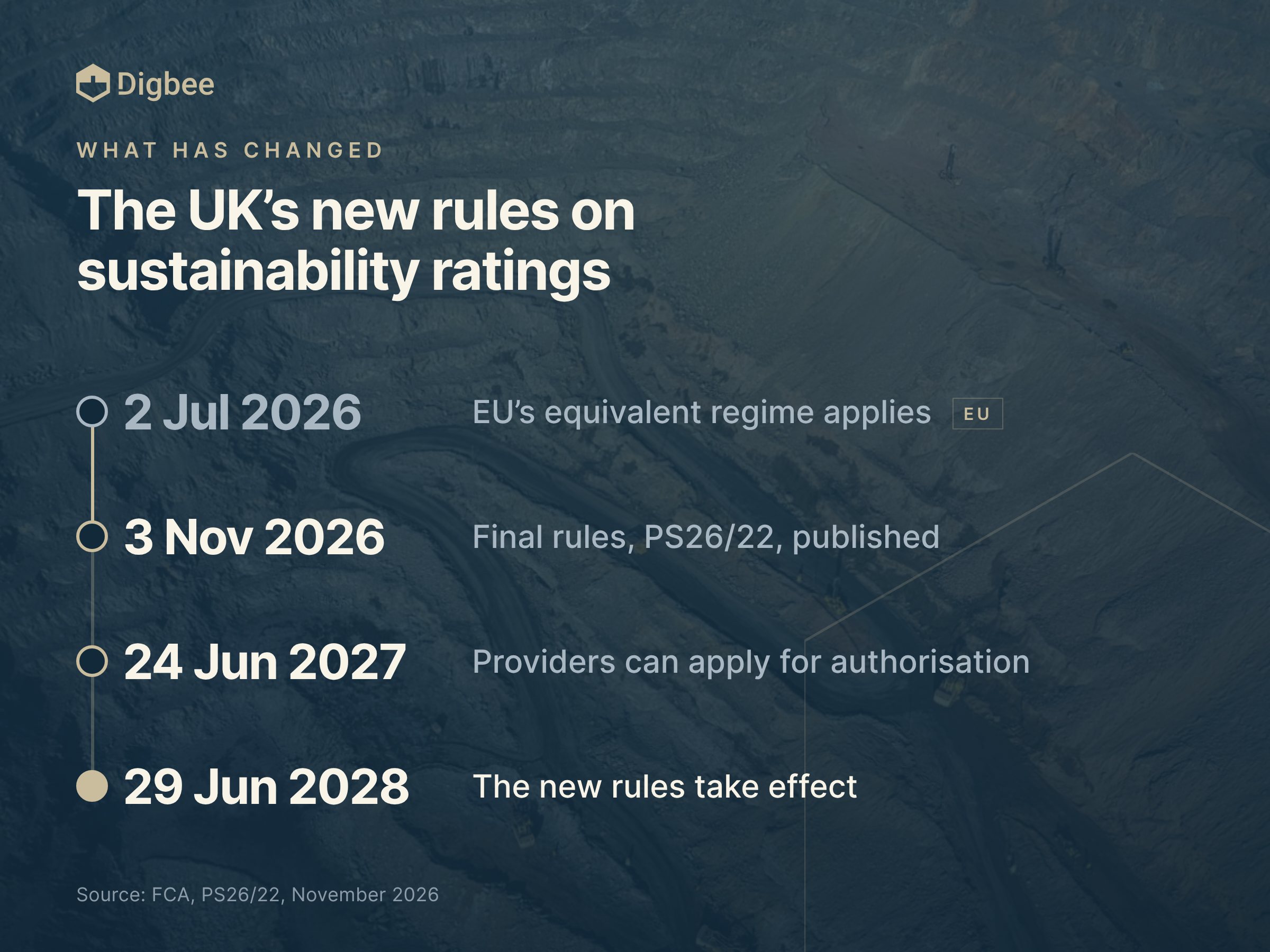
From 29 June 2028, firms providing sustainability ratings in the UK need FCA authorisation. The final rules, PS26/22, were published on 3 November 2026. Providers must be transparent, well governed, properly controlled, manage their conflicts of interest and engage with the companies they rate. The EU’s equivalent regime has applied since 2 July 2026.
Why does a UK rule matter when most mining companies are listed elsewhere?
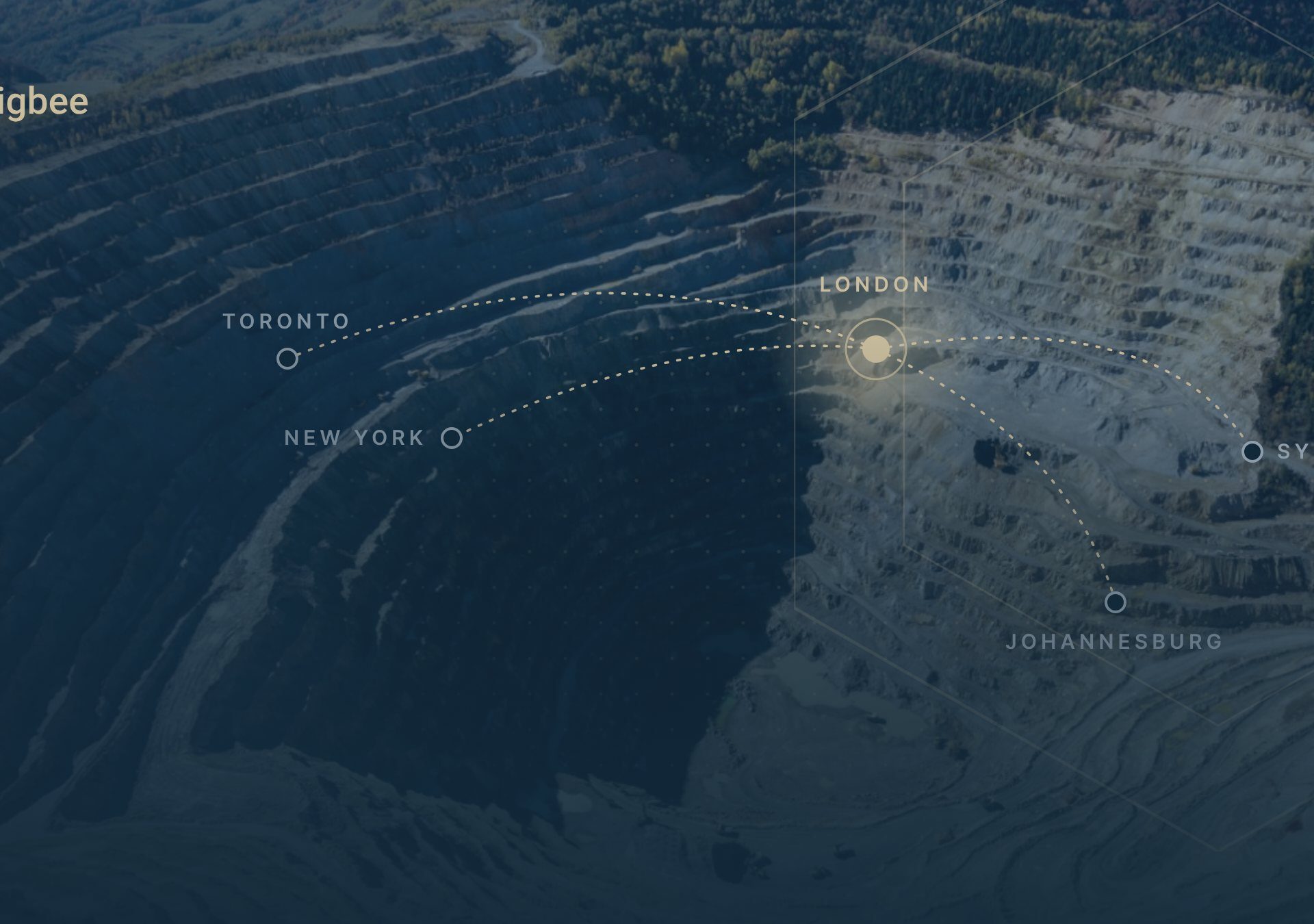
The vast majority of mining companies are listed in Toronto, Sydney, Johannesburg, New York and beyond, not London. The rules reach them anyway, for four reasons.
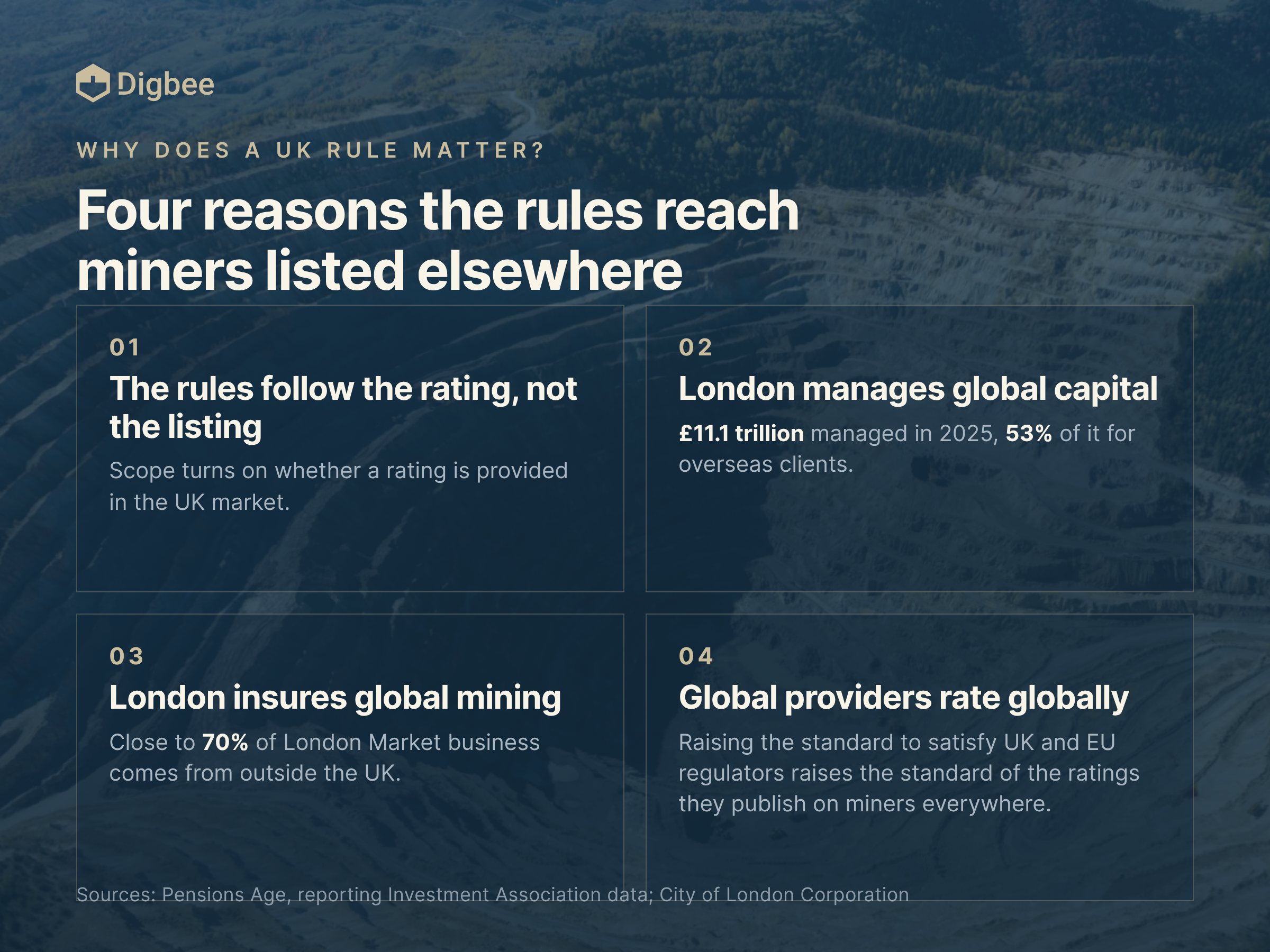
The rules follow the rating, not the listing. Scope turns on whether a rating is provided in the UK market. A TSX-V junior may have no connection to the UK at all. If a provider operating under the regime rates it, the junior still gains the credibility of a regulated rating.
London manages global capital. The UK is the world’s second-largest investment management centre after the US. Its managers ran £11.1 trillion in 2025, 53% of it for overseas clients. Those portfolios hold mining companies from every exchange, and the ratings that inform them must now meet UK standards.
London insures global mining. The London Market is the world’s largest commercial and specialty insurance market, and close to 70% of its business comes from outside the UK. Underwriters pricing mines in Africa, the Americas and Australia increasingly use the same signals investors do.
Global providers rate globally. MSCI, Sustainalytics, S&P Global and other major providers rate companies across every market on a common methodology. Raising the standard to satisfy UK and EU regulators raises the standard of the ratings they publish on miners everywhere.
The model is also spreading. Japan, Singapore, India, Hong Kong, South Korea and Taiwan have built codes or rules on the same IOSCO recommendations. The UK and EU now set the most rigorous version of what is becoming a global standard, much as GISTM did for tailings.
What do credit ratings tell us about where this leads?
Credit ratings have already travelled this road. IOSCO published its code of conduct for credit rating agencies in 2004, when few countries regulated them. Binding rules followed in the US, the EU and the UK, accelerated by the financial crisis.
Today, a credit rating used for regulatory purposes by a UK bank, insurer or fund manager must be issued or endorsed by an FCA-registered or certified agency. Ratings produced in the US, Canada, Australia, South Africa and elsewhere can be endorsed into the UK only where the home country’s framework meets the standard. Regulation in one financial centre raised the bar for credit ratings on issuers everywhere.
No lender asks whether a Canadian or Australian miner is listed in London before trusting its credit rating. They trust it because the agency behind it is regulated. Sustainability ratings are now on the same path, from an IOSCO code in 2021 to binding rules in the UK and EU. Mining companies rated under them can expect the same portable credibility.
Why should the whole mining sector care?
Ratings already shape where capital goes. As Satarla notes, they play a “significant role in decision-making for many institutional investors”. Until now, that influence came with no regulatory oversight.
Regulation turns an unverified signal into a trusted one. A trusted signal moves capital to the sector with more confidence and less friction.
What can mining learn from GISTM?
The Global Industry Standard on Tailings Management was launched in 2020, after the Brumadinho collapse, by UNEP and two London-headquartered bodies, ICMM and PRI. 77 major listed miners committed to it, wherever they were listed. One credible standard lifted trust in the whole industry.
Credible ratings work the same way. Clear risk flags encourage management to mitigate. Transparent methods allow like-for-like comparison, which makes benchmarking meaningful. Trust rises across the sector, and trust draws new capital into mining.
How do trusted ratings benefit every mining company?
Satarla sets out five ways ratings support investor decisions. Regulation strengthens each one.
Coverage and efficiency. A provider can assess far more companies than an in-house team. Juniors and developers that investors would never research directly become visible.
Comparability. A common framework lets investors compare like for like, but only when the method is clear. Mandatory transparency delivers that condition.
Risk identification. Ratings flag exposure to issues such as emissions, supply chains and governance. Proper controls mean those flags rest on sound process.
Benchmarking. Companies see how they are assessed against peers and where to improve. A defined route to engage with providers turns a verdict into a conversation.
Input to decisions. Ratings feed portfolio construction, engagement and client reporting. Regulated ratings give investment committees the confidence to rely on them.
Who carries that trust into mining?
Mining-specific assessment providers serving UK capital, Digbee among them, are preparing for the regime.
That matters. The rules raise the standard for how ratings are produced. They do not make generalist methodologies mining-specific. Mining-native, bottom-up assessment held to a regulated standard is where the sector’s confidence gains most.
What should mining companies do now?
Know who rates you. List every provider that scores your company and which investors, lenders and insurers rely on each. Give each relationship a named owner.
Correct what they hold, and what they read. Providers increasingly use AI to read websites, filings and news. MSCI alone researches companies from 300 public sources. Keep your website and public disclosures current, clearly structured and easy for AI agents to read, and fix stale data with each provider now. Once the rules apply, use the formal engagement route they create.
Have the evidence ready. Assemble the documents a due-diligence team asks for in week one, and have them independently tested before your next raise or renewal.
What is Digbee’s view?
We welcome the rules. A trusted signal helps every company that does the work, just as GISTM helped every operator that adopted it.
Independence is the whole point. Whether or not Digbee falls within the regime’s scope, we will apply its basic principles of transparency, governance and conflict management as our minimum standard.
Jamie Strauss, Founder & CEO, Digbee
Frequently asked questions
Does the FCA regime regulate mining companies? No. It regulates the firms that provide sustainability ratings. Mining companies benefit as the subjects of more transparent, better governed ratings.
When do the new rules take effect? On 29 June 2028. Providers can apply for authorisation from 24 June 2027.
Does it matter to a mining company listed outside the UK? Yes. Scope depends on where a rating is provided and used, not where the rated company is listed or operates.
About Digbee
Digbee is the independent, mining-specific sustainability certification platform. Its bottom-up, forward-looking assessments map to more than 50 global standards and are open to mining companies of any size or stage. Digbee was encouraged into existence by BlackRock and Orion Mine Finance. Through its collaboration with Marsh, Digbee-certified operators can access preferential underwriting terms from Marsh Specie.
Sources
- FCA, New FCA rules bring ESG rating providers into UK regulation for the first time, November 2026
- Satarla, ESG ratings are coming under UK regulation: what it means and how to prepare, 6 November 2026
- Church of England, Mining and Tailings Safety Initiative update
- Pensions Age, Investment management AUM hits record £11.1trn, reporting Investment Association data
- City of London Corporation, The UK’s insurance offer
- Hogan Lovells, Fostering integrity and trust in ESG ratings and data products providers
- IOSCO, Code of Conduct Fundamentals for Credit Rating Agencies, December 2004
- FCA, Use of credit ratings in the UK
- MSCI, Sustainability Solutions brochure, June 2024