Why the metals super cycle is only just beginning — and why the architecture that funds, governs and operates the sector is about to be rebuilt from the ground up
Executive summary
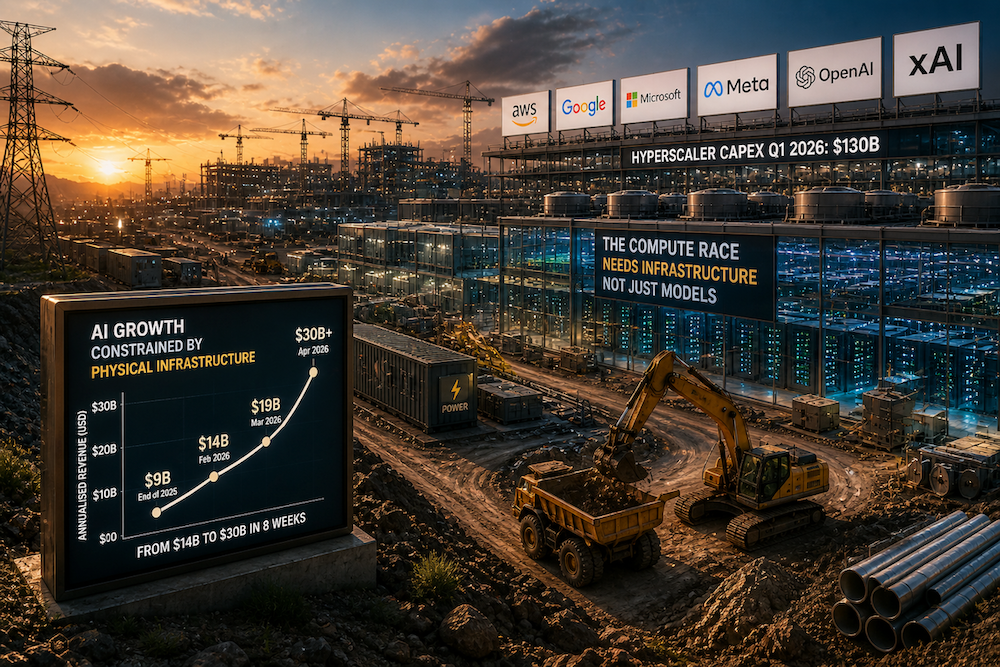
- The signal that the metals super cycle is barely beginning was buried in an AI announcement. In April 2026, Anthropic took a fresh $45 billion from Google and Amazon and still publicly admitted it could not get enough compute. ARR went from $14 billion to $30 billion in eight weeks. One company. The implied physical infrastructure build-out, just for Anthropic, is $105–122 billion at the current per-gigawatt cost. Double it for OpenAI’s stated 30 GW target. Then layer in every other hyperscaler. Combined Q1 2026 hyperscaler capex was $130 billion in a single quarter — three times the inflation-adjusted Manhattan Project. The minerals required to deliver this are not optional. They are gating.
- The mining sector is too small for what is being asked of it — and the timeline has compressed. Global mining trades at $2.16–2.41 trillion. NVIDIA alone is $4.85 trillion. McKinsey now flags the critical minerals capital requirement at up to $5 trillion, with current supply meeting only 10–35% of projected 2050 demand. The capex assumed to be deployed gradually to 2050 — pre-AI, pre-Iran war — is now needed closer to 2035. The sector has to re-rate roughly 5x in market capitalisation on an architecture that demonstrably cannot carry it, and the runway has just been halved.
- The capital infrastructure has already started to reorganise — and the change is structural. Q1 2026 saw private equity reach 22.5% of all metals and mining deal value, up from 1.7% in 2025 and double the previous peak. The $9 billion Mutanda transaction (Orion Resource Partners + the US International Development Finance Corporation) is the template, not the exception. Government and PE are on the same side of the same trade. Specialist capital is moving first; pension funds and generalist institutional capital will follow, not lead.
- The mega private equity groups — Apollo, KKR, Blackstone — are next, and the reason matters. Their 2021 software vintage is producing actual write-offs (Thoma Bravo just took a $5.1 billion equity wipeout on Medallia, with Blackstone, KKR and Apollo absorbing it as creditors). Tech exit multiples have compressed. KKR’s own 2026 outlook now names “AI infrastructure, energy, and critical minerals” as the new security frontier. PE itself has grown so large that it is running out of asset classes big enough to absorb its own dry powder — private credit was the most recent answer; mining is the next. Private equity is not wedded to tech. It is wedded to returns. The returns are now in mining.
- The architectural rebuild is the cycle. Demand is just the trigger. A sector that runs on ~85% project budget overruns, fragmented single-asset developers, artisanal diligence, regulator-aimed disclosure and governance variance unmatched in any other capital-intensive industry, cannot absorb $2 trillion of sophisticated capital on its existing operating model. That capital will rebuild the architecture as it deploys: standardised independent diligence, benchmarked governance, investor-aligned reporting, accelerated consolidation, and the closing of information asymmetry between the issuer and the investor. This rebuild — not the commodity prices — is what produces the multiple expansion from $2T to $10T+.
- For developer-stage management teams and for the capital providers who back them, the implication is direct. The companies and capital partners who position themselves within the new architecture — independently verified, benchmarked, institutionally legible — before they are forced into it will lead this cycle. Those who do not will spend it negotiating on the investor’s terms, with longer timelines, higher dilution, and a smaller share of the re-rating.
A short note on what this is
This is a short, deliberately limited piece of research. It does not attempt to model commodity demand. It does not forecast prices. It makes one argument in two parts: the early signal of the cycle was hiding in plain sight in an AI press release, but the more important story is the architectural rebuild that the new capital will impose on the sector as it deploys. Demand is the trigger. The rebuild is the cycle.
A note on context. As Janan Ganesh observed in the Financial Times this week, the decade is becoming “an education in the importance of the three-dimensional.” The metaverse has shrunk to a humbled remnant. The techno-utopian belief that physical distance and physical resources would matter less is meeting reality on every front — in the Strait of Hormuz, in Ukraine, in the global competition for energy, and most of all in the realisation that “this decade’s great breakthrough in the ‘bit’ sphere — AI — has become a quest for (physical) data centres and the (physical) energy that fuels them.” Atoms have reasserted themselves over bits. The physical economy is back at the centre of the strategic conversation. The mining sector sits at the absolute base of that conversation, and the capital that recognises this earliest will be best placed to benefit from it.
1. The tell
In April 2026, Anthropic announced it had raised a fresh $45 billion from Google and Amazon and was still unable to get enough compute. Annualised revenue had gone from roughly $9 billion at the end of 2025 to $14 billion in February, to $19 billion in March, to over $30 billion by April. From $14 billion to $30 billion in eight weeks. Over 1,000 enterprise customers now spend more than $1 million annually on Claude — double the figure from two months earlier. Dario Amodei’s own words: “Our users tell us Claude is increasingly essential to how they work, and we need to build the infrastructure to keep pace with rapidly growing demand.”
Read that sentence carefully. The CEO of one of the most valuable private companies on earth is publicly admitting his business is being throttled — not by demand, not by competition, not by the model — but by his ability to source enough physical infrastructure.
In the same window, Anthropic committed to spending more than $100 billion on AWS over ten years for up to 5 gigawatts of compute capacity, plus a separate Google deal that secures 1 GW already coming online in 2026 and another 3.5 GW from 2027. Industry analysts at The Next Platform estimate the all-in cost of TPU capacity — including datacentres, power, cooling and iron — at $30–35 billion per gigawatt. Anthropic’s commitments alone therefore amount to somewhere between $105 and $122 billion in physical infrastructure build-out, just for one company, over the next few years.
Now double it for OpenAI, which is publicly targeting 30 GW of compute by 2030 — call that another $900 billion to $1 trillion at the same per-GW cost. Then layer in Google, Microsoft, Meta, Amazon (own use), xAI, the Chinese labs, the sovereign AI programmes, and the long tail of independents.
The combined hyperscaler capex in Q1 2026 alone was $130 billion — three times the inflation-adjusted cost of the Manhattan Project, in a single quarter. Their full-year 2026 capex commitments now range from $635 billion to $700 billion. And nobody who has read the Anthropic announcement honestly believes that number is the ceiling for 2027 or 2028.
This is not a tech story. This is a metals story dressed up as a tech story. It is the moment that the most valuable companies in the world admitted, in public, that their growth is now constrained by the physical economy.
2. What hyperscale compute actually consumes
A hyperscale data centre consumes 60–75 tonnes of minerals per megawatt — overwhelmingly in power and cooling systems, not in servers (World Economic Forum). BloombergNEF puts copper alone at around 27 tonnes per MW for AI facilities. Microsoft’s 80 MW Chicago site used roughly 2,100 tonnes of copper.
The Copper Development Association estimates a single hyperscale AI facility can require up to 50,000 tonnes of copper. Wood Mackenzie already forecasts a 304,000-tonne refined copper deficit for 2025 and a wider gap in 2026. The IEA puts copper on a path where existing and planned mines meet only about 70% of the projected 2035 demand. WoodMac: closing that gap would require $210 billion in new copper investment alone, compared with the $76 billion deployed over the previous six years.
Copper is one metal. Iron ore, nickel, aluminium, the rare earths, lithium, cobalt — every one of them sits under the same demand curve, driven by the same forces overlapping at once: AI infrastructure, electrification, the energy transition, the grid build-out, and defence.
Demand is not the question. Demand is settled. The question is whether the sector that has to supply it is fit for the job.
3. The valuation comparison nobody is making
The global mining sector — every public miner, from BHP and Rio Tinto down to the smallest junior — has a market capitalisation of roughly $2.16 trillion to $2.41 trillion.
NVIDIA, on its own, trades at approximately $4.85 trillion.
One company. Twice the value of every miner on earth combined. A sector that supplies the physical input layer — the copper, steel, nickel, lithium, cobalt, and rare earths — without which the $5 trillion company cannot grow at all.
Mining represents around 1% of MSCI. It has been treated as a residual asset class for fifteen years. That is precisely why the architectural opportunity is asymmetric. The sector has not been rebuilt because no one with the capital, mandate, or technical sophistication to do so has been in the room. That is now changing.
4. The architectural problem
Before discussing the new capital, the piece has to be honest about what is wrong with the current architecture.
A sector that has to absorb $2 trillion of new capex over the next two decades, and re-rate from $2 trillion to $10 trillion of market capitalisation in the process, cannot do so on the operating model it has today. The numbers do not work. The constraints are well-rehearsed but worth setting out plainly:
Roughly 85% of mining projects run materially over budget. That is not a margin issue. It is a structural barrier to the cost of capital required to fund a $2 trillion build-out. No sophisticated allocator can underwrite a thesis at scale against that base rate.
The sector is fragmented. Below the majors, there are thousands of single-asset developers and explorers, most undercapitalised, most without the operating depth to deliver projects on time and on budget, most reliant on episodic equity raises into a generalist investor base that has progressively walked away from the sector for fifteen years.
Diligence is artisanal. Each financing event is essentially a bespoke piece of work. There is no shared, independently verified evidence base that allows a Tier 1 investor to compare two developer-stage companies on a like-for-like basis on operational risk, governance maturity, community licence, or management discipline. That absence is not a feature of the asset class. It is a legacy of a capital base that did not demand otherwise.
Information flow is poor. Disclosure standards remain dominated by regulatory frameworks designed for environmental compliance rather than investor decision-making. Sustainability reporting in particular has been pulled toward the audience that makes the most noise — regulators and NGOs — rather than the audience writing the cheques.
Governance and operating discipline are uneven. The variance between a top-quartile and bottom-quartile management team, on any objective measure, is wider in mining than in any other sector of equivalent capital intensity.
Each of these problems is manageable individually. The point is not that the sector is broken in isolated places. The point is that the architecture, taken as a whole, has never been rebuilt for the modern era of institutional capital.
This needs stating carefully, because important structural progress has been made this century, and the piece should not pretend otherwise. The introduction of NI 43-101 in Canada in 2001, JORC in Australia (codified in 1989 and substantially modernised since), the Equator Principles for project finance, and the IFC Performance Standards on environmental and social risk all represent genuine institutional architecture that simply did not exist a generation ago. The technical reporting of mineral resources and reserves is now meaningfully more rigorous than it was. Project finance in large mines is meaningfully more disciplined. These frameworks have been real and useful, and the sector deserves credit for them.
But — and this is the important qualification — those frameworks address technical disclosure and project finance. They do not address the capital, governance and management architecture of the developer and producer ecosystem itself. They do not give an institutional allocator a basis on which to compare two mining companies — whether developer-stage or in production — on operational risk maturity, on management discipline, on social licence quality, on sustainability impact as a leading indicator of operational performance, or on any of the other dimensions that determine whether a company will actually deliver predictably. The same dimensions that determine whether a developer’s next project lands on time and on budget are the dimensions that determine whether a producer’s next quarter does. These frameworks do not standardise the investor-grade evidence base required for the next $2 trillion of capital. And critically, the sector continues to act, in its disclosure practices and capital-raising approach, as though even those technical improvements had not been made. Most management teams still arrive at financing and strategic conversations unprepared, on story rather than evidence, and largely ignorant of how materially more sophisticated institutional capital is in this cycle, and of what it now requires of them.
Mining is the original extractive industry of the global economy. Its basic operational shape — capital-intensive, geographically remote from its capital providers, and episodic in its capital cycles — has persisted through nationalisation, privatisation, the commodity supercycle of the 2000s, and the long 15 years of neglect that followed. Every other capital-intensive industry of comparable importance — energy, infrastructure, real estate, healthcare, banking — has, in turn, been overhauled by sophisticated institutional capital. Mining is the last one standing. It is not just under-managed for two decades. It is still structurally operating against the expectations of a previous era of capital, and the cycle now beginning is the one that finally rebuilds it for the era now arriving.
A connected and under-discussed point on the same architecture: the sector has a talent problem that is now actively shaping its returns. The average age of mining C-suite executives is 55 and rising. Tech runs at 35–45. Yet total compensation in tech is materially higher than in mining — despite mining’s significantly higher per-head capital intensity, longer-duration assets, and direct exposure to the demand themes (AI infrastructure, electrification, energy transition) that are creating the value in the first place. This is not just an awkward fact about the sector; it is an opportunity. The talent arbitrage available to a sophisticated owner-operator who can attract younger, technically literate, financially fluent management into mining is structurally large. The first PE-backed platforms to do this at scale will outperform peers on operating discipline alone, before any other lever is pulled.
That is the industry that has to absorb $5 trillion of new capital and re-rate to $10 trillion+ in market capitalisation. That architecture cannot carry it.
5. The capital infrastructure has already started to reorganise
The 2000s super cycle was funded by hedge funds and generalist resource funds. That capital base has gone — eroded by years of poor commodity returns, ESG-driven divestment, and the migration of capital to technology. What is replacing it is structurally different and far more sophisticated.
A short, important acknowledgement is owed here. For most of the last fifteen years, the sector has been kept alive by a small number of remarkable individuals — Eric Sprott, Frank Giustra, Rick Rule, and a handful of others — whose conviction, capital and willingness to back operators when nobody else would have almost single-handedly prevented the developer and explorer ecosystem from collapsing. The sector should be grateful. But the necessary quantum of capital required for what is now coming will outpace and outgrow these brave souls. They were the bridge. They were never going to be the cycle.
Specialist private equity has moved first. S&P Global reports that in Q1 2026 alone, private equity accounted for 22.5% of all metals and mining deal value — more than double the previous peak set in 2023, and against just 1.7% in 2025. The driver was a single $9 billion deal: Orion Resource Partners and the US International Development Finance Corp acquiring a 40% stake in the Mutanda and Kamoto copper-cobalt assets in the DRC. A government-private equity partnership for battery metals. That is not a coincidence. It is a template.
Strategics are consolidating. Mid-tier producers are being driven to scale up to compete with the BHPs and Rio Tintos. Security of supply has moved from a slogan to a board-level mandate, particularly in North America and Europe.
Pension funds and traditional institutional capital will be pulled in by momentum. They follow specialists; they do not lead them.
6. The real surprise — the mega private equity groups
The genuinely under-appreciated shift, and the one that will define the architecture of the next decade, is the entry of the largest alternative asset managers — Apollo, KKR, Blackstone and their peers — into mining at scale.
A simple framing helps here. Private equity is not wedded to any sector. It is wedded to returns. It goes wherever the risk-adjusted return is best for a decade, which means technology, and specifically software. That trade is now broken in a way that the headlines have only just started to register.
The 2021 vintage is producing actual write-offs. In April 2026, Thoma Bravo handed Medallia back to its creditors — a $5.1 billion equity wipeout on a $6.4 billion 2021 take-private. The lenders absorbing the company are Blackstone, KKR, Apollo and Antares. It is the second total wipeout in the category after Pluralsight. As Jason Lemkin observed, “It wasn’t the leverage that killed it. It was the price.”
The exit market for software has narrowed. Public market multiples have compressed, the IPO window is selective, and AI is doing to traditional SaaS what SaaS once did to enterprise software — call it SaaSpocalypse, call it agentic disruption, the effect on exit valuations is the same.
The largest sponsors are publicly repositioning. KKR’s own 2026 outlook now states explicitly: “National security concerns around AI infrastructure, energy, and critical minerals are rising. Security is now being defined far more broadly to encompass resiliency.” That is the language of a firm telling its LPs where the next decade of capital is going.
The reasons this rotation lands on mining rather than anywhere else are structural, and each one points back to the architectural rebuild:
- Multi-decade demand visibility. Energy transition, electrification, AI infrastructure, defence, grid build-out — overlapping themes, all metals-intensive, all running for the next twenty years minimum. PE rarely gets to underwrite a thesis with this many independent demand drivers stacked on top of each other.
- They understand the demand levers better than the sector does. These firms have spent a decade financing the data centres, the cloud platforms, the grid build-out, and the energy transition that are now driving metals demand. They have written the cheques. They know what the hyperscalers need, when they need it, and at what cost.
- Valuation. Mining majors trade at low single-digit EBITDA multiples. The sector is around 1% of MSCI. There is nowhere left to compress.
- Geopolitical alignment. Western governments — led by the United States, but increasingly mirrored across Europe, Canada, Australia and Japan — are now actively encouraging rapid expansion of new metal supply, both for basic demand reasons and for security of supply. The Mutanda transaction is the cleanest expression of that. Government and PE are on the same side of the same trade.
- The architectural opportunity is the largest available anywhere in industrials, and PE simply needs an asset class large enough to deploy into. The largest sponsors now manage so much committed capital that they have an active problem identifying asset classes of sufficient size and depth to absorb it. Private credit was the most recent answer to that problem, and it has now begun to crowd. Mining offers something private credit never could: a $2 trillion sector that has to triple in market capitalisation to meet physical demand, the sponsors themselves have helped create on the demand side. The 85% project-overrun number, the fragmentation, the inconsistent governance, the artisanal diligence — these are not just problems for the existing operators. To a mega private equity sponsor, they are the precise conditions under which large amounts of capital can be deployed against operational improvement. A sector that has been under-managed for fifteen years and operating against the expectations of a previous era of capital for far longer is exactly the sector where a sophisticated owner-operator can compress costs, professionalise process, consolidate scale, and re-rate the multiple.
There is a second-order point here that capital providers and advisers should not miss. Once the mega sponsors have done the diligence work — once Apollo, KKR or Blackstone is publicly on a deal — the rest of the capital architecture follows them in. Traditional asset managers, sovereign wealth funds, the larger pension funds, the long-only generalist managers who currently treat mining as uninvestable: all of them watch what the largest alternative managers do, and use their presence as the signal that risk has been priced. The first move legitimises the sector for everyone behind them. That is how the multiple expansion actually compounds.
7. The clock matters — and PE knows it
A point worth pausing on, because it changes the urgency calculus for management teams.
Private equity does not allocate on infinite horizons. The average fund has a ten-year life. As Tom Grönlund of Appian Capital Advisory recently observed in the S&P Global Insight piece on PE’s metals & mining surge, “private equity’s timeline is more accelerated than that of public companies. With an average fund life cycle of a decade, private equity firms need to stay on track to make the change, create the value and then be able to exit later on.”
That sentence is doing a lot of work, and it is worth reading twice. The fund managers entering mining now have to identify the asset, deploy capital, drive operational change, achieve the value uplift, and exit — all within a ten-year clock that has already started. They will not move slowly. They will not allocate to companies that require five years of clean-up before they can credibly sustain institutional capital. They will allocate to the management teams that are already in the right operational shape, or to platforms where the rebuild can be imposed on day one of ownership.
This is the rate-of-change argument. The sector has fifteen years of work to compress into one fund cycle. Most of that work will fall on the management teams of companies the sponsors choose to back, and those choices will be made on evidence, not story.
8. What “fit for purpose” actually means
If the previous sections are right, the question becomes: what does the rebuilt architecture actually look like? On any reasonable horizon — five years, certainly ten — a developer-stage company is going to be operating in a sector that looks materially different from the one in which it raised capital two years ago. The shifts are already visible.
Capital will be specialist, patient and operationally engaged. It will write larger cheques, hold longer (but not indefinitely — see the Appian point above), and demand more of management. The era of the episodic generalist, which rises into a fragmented public investor base, on a story rather than evidence, is closing.
Diligence will be standardised. Investors deploying at scale need comparability. The current artisanal model — every financing a bespoke project — does not scale to $2 trillion of capex. Independent, mining-specific frameworks of operational and sustainability evidence, applied consistently across thousands of companies, become the substrate that allows institutional capital to allocate efficiently. There are clear precedents in adjacent sectors. Real estate institutionalised at scale, partly on the back of GRESB, the global benchmark that allowed pension funds and sovereign capital to compare property portfolios on a like-for-like basis on sustainability and operational performance. Technology institutionalised partly on the back of Gartner’s Magic Quadrants and similar third-party frameworks, which gave enterprise buyers and capital allocators a shared vocabulary for evaluating vendors. Mining has no equivalent yet. It will. This is not a theoretical shift; it is already happening at the edges, and it will harden into expectation.
Governance and risk management will be benchmarked. Management teams will be evaluated against an objective base rate. Predictability — delivering against guidance, on budget, on time — will be priced as the single most valuable management characteristic. Variance from that base rate will become an explicit valuation discount.
Reporting will be re-aimed at the people writing the cheques. Sustainability disclosure in particular will pivot away from the regulator-and-NGO audience it has been built for, and toward the financial audience that actually allocates capital. The frameworks will look more like financial diligence and less like compliance theatre. Critically, sustainability impact will be understood for what it actually is: a leading indicator of operational performance and predictability. A company that manages community relations, water, tailings and workforce well is a company that is materially less likely to deliver a project late, over budget, or with a permitting setback. Sustainability is not a separate domain from financial performance. It is one of the strongest available signals of it. The new capital understands this. The disclosure frameworks will be rebuilt accordingly.
Consolidation will accelerate. The mid-tier will scale. Single-asset developers without operational depth will either be absorbed or starved. Strategic acquirers and PE-backed platforms will both be active simultaneously — the first time the sector has seen that pattern at scale since the 2000s.
Information asymmetry between the issuer and investor will close. Today, the developer-stage CEO often knows materially more about the operational state of their company than the investor across the table. In a world where independent verification and benchmarking are standard, that gap narrows. Counter-intuitively, that favours the well-run management teams — because the asymmetry was never their friend; it was the friend of the laggards who hid behind it.
None of this is speculative. Each of these shifts has a precedent in another sector that went through the same architectural rebuild — shale gas in the 2000s, infrastructure in the 2010s, and healthcare services repeatedly. The pattern is consistent: when sophisticated capital arrives in size, the architecture follows it within a single capital cycle.
9. The shale parallel
A useful precedent: Eric Belz, formerly of Engine No. 1 and now founding JDH Capital, made the case in a 2024 conversation that what private equity did to US shale gas in the 2000s is the closest historical analogue to what is now beginning in mining. The shale revolution did not happen because the geology was new. It happened because a particular kind of capital — patient, technical, willing to back operators against the consensus — moved in at scale, professionalised the operating model, drove consolidation, and ultimately handed a transformed industry (the oil industry) back to the public markets at materially higher valuations.
That cycle followed a recognisable pattern. Specialists moved first. They imposed operating discipline. Strategies followed and consolidated. Public markets re-rated the sector. Generalist institutional capital arrived late and paid up.
The early innings of that same pattern are visible in mining today.
10. The prediction
The mainstream forecast for the energy transition was that the mining sector would need somewhere on the order of $2 trillion of new capex by 2050 to meet decarbonisation demand. McKinsey’s most recent work raises that estimate to as much as $5 trillion of critical minerals capital need, while reporting that current mineral supply meets just 10–35% of projected 2050 demand. Demand for individual minerals could rise 100% (nickel) to 700% (lithium) before 2030.
The point worth making here is not just that the absolute number is larger than was being modelled even two years ago. The point is that the timeline is being compressed. The 2050 framing assumed a gradual, policy-led deployment over twenty-five years. Three forces have collapsed that timeline.
First, AI infrastructure. Some baseline data centre demand was already in the models. The AI-driven step-change on top of it was not, and AI facilities are substantially more mineral-intensive per megawatt than the conventional facilities the models assumed, with denser racks, heavier electrical backbones and more robust cooling (WEF; Schneider Electric). Roughly 100 GW of new hyperscale capacity is now forecast to come online by 2030, increasingly AI-optimised. At 60–75 tonnes of minerals per megawatt for general hyperscale (and higher for AI-specific builds), that is 6–7.5 million tonnes of additional minerals for data centres alone — including ~2.7 million tonnes of copper, equivalent to over 12% of total annual global copper production, dropped on top of every other source of demand. With supply-chain geopolitics tightening simultaneously, the pressure on the industry to respond is acute.
Second, the Iran war has accelerated EV and renewable adoption. The closure of the Strait of Hormuz and the resulting fossil fuel shock have produced a genuine step-change in consumer and policy behaviour, particularly in Asia. Chinese EV exports rose 140% year-on-year in March 2026. Vietnam’s EV market expanded 100–150% in the same window. Thailand’s growth grew 150%. India’s registrations rose 24%. Solar, battery and EV exports from China collectively rose 70% in March year-on-year. The UK Energy Secretary’s framing — “the era of fossil fuel security is over, and the era of clean energy security must come of age” — is becoming the consensus political position across the West and across Asia. As the IEA’s Fatih Birol put it, “I expect one of the responses to this crisis will be acceleration of renewables. Not only because they are helping to reduce the emissions, but also, they are a homegrown domestic energy source.” The conclusion is direct: the demand curve for the energy-transition minerals is being pulled forward, not delayed.
Third, defence and security spending is layering on top of these civilian demand curves with its own metals intensity, accelerated again by the events of 2025–2026.
The realistic conclusion, taking the McKinsey estimates and the demand acceleration together, is that the capex previously assumed for 2050 is now needed closer to 2035 — and may need to be deployed by a sector whose own productivity, by McKinsey’s own assessment, “has just not progressed” in two decades.
That capital will not come from the hedge fund desks of the 2000s. It will not come predominantly from the resource funds of the 2010s. It will not come from the small group of remarkable individuals who have kept the developer ecosystem alive for the last fifteen years. It will come from the largest alternative asset managers in the world, supported by sovereign and government co-investment, financing the consolidation and architectural rebuild of a sector that has been starved of sophisticated capital for fifteen years and operating against the expectations of a previous era of capital for far longer.
The result, on a horizon long enough for any developer-stage management team currently in the field, is a sector that re-rates from a $2 trillion total market capitalisation to $10 trillion or more — driven not just by demand growth, but by the multiple expansion that follows when an industry is reorganised around modern capital structures, modern operating discipline, modern reporting, and modern risk management.
The capital is the catalyst. The architectural rebuild is the cycle. And the clock has been pulled forward by a decade or more.
11. What this means for developer-stage mining companies — and the capital providers who back them
The implication is uncomfortable but clear, and it cuts in two directions.
For management teams: the capital arriving in this cycle is fundamentally more sophisticated than the capital that funded the last one. It will reward management teams that look prepared, operate against an institutional risk framework, and can demonstrate independent verification of their operating practices. It will discount heavily — the rest. The companies that survive and lead this cycle will be the ones that recognise the architectural shift early and position themselves inside the new architecture before they are forced into it.
For capital providers and advisers: the same logic applies, with arguably higher stakes. For the last fifteen years, the sector’s capital base has been kept functional by a handful of wealthy and conviction-driven individuals — Sprott, Giustra, Rule, and others like them — to whom the industry owes a real debt for keeping the lights on through a long winter. But the necessary quantum of capital this cycle requires will outpace and outgrow even those remarkable individuals. The next fifteen years will not be funded by a small number of brave personal cheque-writers. It will be funded by institutional capital architecture. The brokers, banks and capital introducers that adapt their offering to that new architecture — that bring their issuer clients to the table already independently verified, already benchmarked, already legible to the institutional buyer — will own this cycle’s deal flow. Those that continue to operate on the old model, marketing stories and management chemistry into a generalist investor base that no longer exists at scale, will find themselves intermediating progressively smaller pools of capital against progressively more demanding allocators.
The architectural rebuild is not just an issue. It is an entire value chain problem. The advantage goes to the issuer-and-adviser pairings that recognise that first.
12. Closing observation
The clue that the super cycle was real and just beginning was not in a copper price chart, an IEA forecast, or a Wood Mackenzie deficit model — though all of those exist and all point in the same direction. The clue was in an AI company taking $45 billion of fresh capital from two of the world’s largest companies in a single quarter, and still not having enough compute to serve its customers.
But the more important observation is what that demand pressure is about to do to the shape of the mining industry — not just its size. The sector that emerges from the next decade will be more concentrated, more disciplined, more independently verified, and more institutionally owned than the one that exists today. That is the actual cycle. Demand is just what made it inevitable.
To return to where this note began. As Janan Ganesh wrote in the Financial Times, “bit by bit, so to speak, people are learning to treat the world as a physical object, which is wise, as no other terms were ever on offer.” Mining is the physical object at the base of the global economy. The capital cycle that funds and rebuilds it over the next twenty years will be one of the largest reallocations of institutional money in modern industrial history.
The question for developer-stage management teams, and for the capital partners they choose to work with, is no longer whether the cycle is coming. It is whether they will be inside the new architecture, or outside it, when the most discriminating capital in the world arrives at their door.
Jamie Strauss, Founder & CEO, Digbee
Sources include: Anthropic (April 2026); TechCrunch; CNBC; Axios; The Next Platform; Fortune; SaaStr / 20VC; Reuters; Bloomberg; S&P Global Market Intelligence (including comments by Tom Grönlund of Appian Capital Advisory); KKR 2026 Outlook; Wood Mackenzie; IEA Critical Minerals Outlook (including comments by Fatih Birol); World Economic Forum; BloombergNEF; Copper Development Association; The Business Research Company; Visual Capitalist; McKinsey & Company (multiple reports including “The net-zero materials transition”, “The hard stuff: Navigating the physical realities of the energy transition”, and PDAC 2025 remarks by Brad Lahaie); Ember; Transport & Environment; Janan Ganesh, “A decade that promised to have us living via avatars now feels all too tangible,” Financial Times. A 2024 conversation with Eric Belz (formerly Engine No. 1; now JDH Capital) informs the shale parallel.